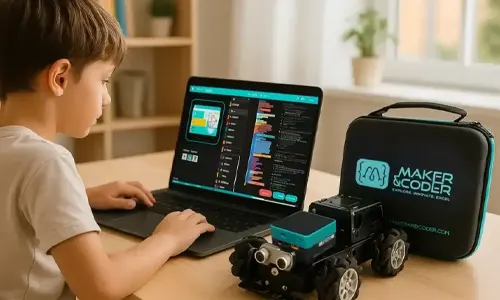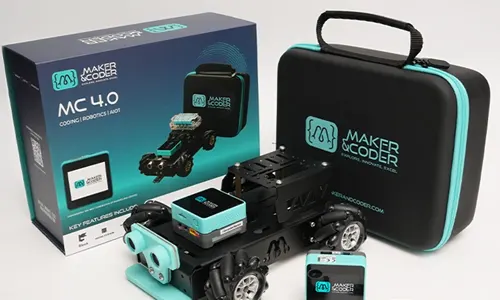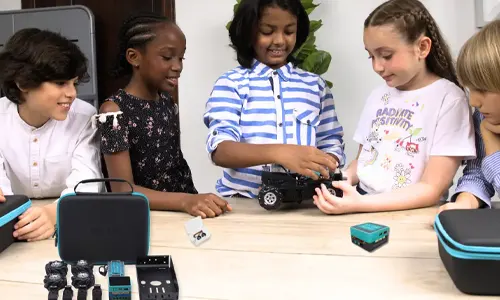
What Is a Robotics Starter Kit?
A robotics starter kit optimally combines all the basics of robotics, electronics, and programming into one, user-friendly, educational device. The robotics kit consists of essential components such as a microcontroller, which could be an Arduino or a Raspberry Pi, and, to start, some wheels, motors, and parts of the chassis, as well as a multitude of cables and connectors. Also, with user manuals and guides present, learners with little to no experience will be able to build and program their first robotic project easily.
These kits are also useful to educators, learners, and enthusiasts, which makes their value so high. Such users are able to engage with robotics most simply and conveniently as possible. The robotics starter kit allows users to learn crucial concepts like motor and sensor integration, along with the fundamentals of programming, instead of getting bogged down with elaborate technical setups due to all the parts being pre-selected.
Designed for Learning and Exploration
Through the robotics starter kit, all users of any educational institution are able to be introduced to STEM. In the process of trying to solve their problems in the robotic world, engaging with science, technology, engineering, and mathematics, learners find the kit very useful to improve their critical thinking, creativity, and problem-solving actively. After or before school, in clubs, and for home projects, these kits are able to provide learners with the infrastructure to work with and through play and trial and error. These robotics kits help them learn world engineering concepts.
What Makes a STEM Robotics Starter Kit Different?
A STEM Robotics Starter Kit is distinct because it includes assembly, thus offering a more well-rounded form of learning across various disciplines such as science, technology, engineering, and mathematics. The purpose of these kits goes beyond mere entertainment as they help students conceptualise the basic principles of a given STEM subject through active design and programming.
Designed for Educational Impact
Unlike most kits, a STEM Robotics Starter Kit fosters critical and analytical thinking and inquiry-based learning coupled with hands-on experimentation. Students are motivated to create robotic devices, and in the process, they learn how to integrate sensors, motors, and controllers in a robotic system—bridging the abstract with the tangible.
Lesson plans and activity guides structured to meet school learning outcomes are included in the kits. Such materials enable educators and parents to design and scaffold learning pathways for novices, strengthening school learning. Furthermore, the kits facilitate both structured and unstructured projects.
This blend allows learners to embrace their creativity and master coding, automation, teamwork, and perseverance. The STEM Robotics Starter Kit equips students for a technology-driven world by integrating academic concepts with practical applications, offering interactive learning tools and hands-on robotics devices.

Key Components of an Educational Robotics Starter Kit
An Educational Robotics Starter Kit strives to give students a practical entry to robotics and coding. These kits are very well put together to meet STEM learning goals and offer hardware and software to aid in practical learning and the development of essential skills.
Essential Parts Inside an Educational Robotics Starter Kit
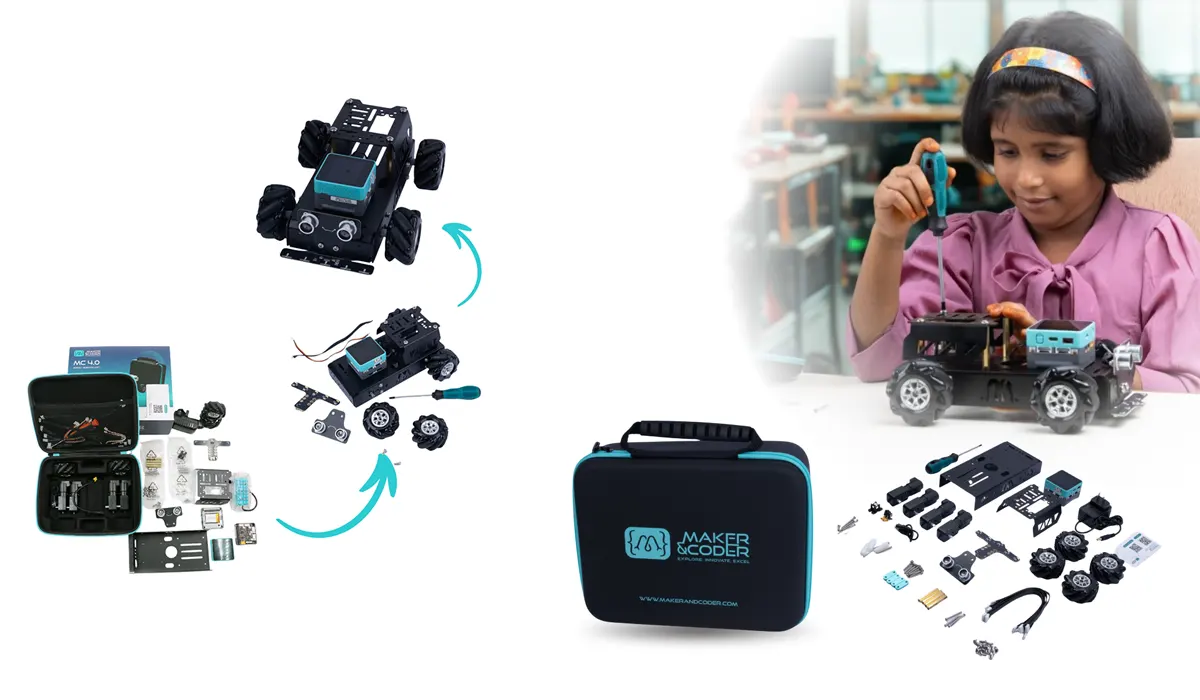
Most of the educational robotics starter kits contain a microcontroller board, such as an Arduino or compatible substitute, which acts as the brain of the robot. Allied to this are several input and output modules (sensors of light, distance and temperature, motors, LEDs and buzzers) which enable the construction of interactive projects. To support the components, some kits include breadboards, jumper wires, and USB cables, which will allow circuit construction and connectivity.
Programming Interfaces and Software Tools
A few kits offer components such as wheels, chassis frames, and mounting hardware to enable the construction of mobile robots. In addition, the kits come with user-friendly interfaces that allow the learners to program the robots using drag-and-drop or text-based coding. To support guided and self-paced learning, well-structured instruction manuals and curriculum guides are also provided.
The students receive the parts of mobile robots as well as acquire skills in electronics, mechanics, computer programming, and related fields systematically and constructively. Therefore, the kits are necessary when teaching robotics STEM in schools and homes.
Getting Started with a Robotics Starter Kit for Beginners
Unboxing and Identifying Components
A beginner’s robotics kit usually consists of basic electronic parts, including sensors, motors, and a microcontroller board (Arduino or micro: bit). In addition, the kits also contain jumper wires and a USB cable. If possible, take time to recognise and organise each part. Most kits also include manuals or provide online guides to assist you in identifying the parts along with their functions.
Setting Up Your First Project
Building anything requires some form of planning. Before starting the building process, make sure to install necessary applications such as the Arduino IDE or block-based programmes like Scratch and connect the microcontroller to your computer. Running basic tutorial exercises, such as LED blinking or motor operation, will be helpful. Coding and wiring will be more intuitive to you as you progressively get comfortable.
Learning by Doing
Hands-on practice greatly enhances your learning, so strive to accomplish simple tasks first, including building robots that can follow and avoid obstacles. For beginners, a robotics starter kit is an invaluable resource and greatly simplifies the process.
Programming Basics with a Robotics Starter Kit
Introducing Code to Your First Robot
A robotics starter kit is more than simply putting parts together; it is an introduction to the world of programming. Most kits come with software specific to elementary level users, like Scratch, Blockly, or Arduino IDE, which control the robots and teach coding to children and novices. Users may route commands to prevent movement or turning through a simple script or via drag and drop.
Learning Core Programming Concepts
With a robotics starter kit, learners may also grasp key programming concepts like loops, conditionals, variables, and event-driven logic. These concepts are essential to designing the robots’ logic for environmental interactions like obstacle avoidance and line following. Advanced students can design and build more responsive programmes by using real-time sensor data as feedback and utilising responsive actions as programming.
Most importantly, these kits aim to eliminate the dread associated with programming by removing complexity and providing small, easily solvable puzzles. Learning by doing is not only practical, it is fun. Encouraging robotics starter kits as an introduction to programming helps children and beginners build interest in computational thinking, which is applicable in various fields.
How to Use STEM Robotics Starter Kits in School or Home Settings
STEM robotics starter kits are multifunctional aids for stimulating active learning both in the classroom and at home. They facilitate the introduction of STEM concepts through the construction and programming of robots.
In the Classroom
In the classroom, STEM robotics starter kits can be integrated into lesson objectives for computer science, physics, and engineering, and instructional goals in STEM disciplines can be enhanced. Robotics tends to be engaging and motivates both children and adults, which can be harnessed in the form of collaborative group challenges where participants design robots for specific goals. These activities are adaptable to different age groups and within-group abilities.
At Home
STEM robotics starter kits enable parents to actively participate in guiding their children’s learning. They can direct through step-by-step tutorials, or children can explore independently. Many STEM robotics starter kits are available with supplementary materials, such as coding applications or instructional videos, which help learners build programming skills in a low-pressure atmosphere.STEM kits boost creativity, curiosity, and technical skill in all settings, creating a robust groundwork for future STEM accomplishments.
Common Challenges Beginners Face—and How to Overcome Them
Diving into a robotics starter kit can be exhilarating and stressful at the same time, especially for those without a background in electronics or programming. Even though these kits cater to beginners, some persistent problems continuously arise in the course of learning robotics.
Overcoming Confusion in Assembly and Wiring
Robotic kits come with a range of components, such as sensors, motors, and microcontrollers, all of which need to be connected in a certain schematic for proper functioning.
Most users face assembly and wiring issues, hence needing to reconfigure for optimal connection when miswiring has already turned off the device or caused faults in the kit. This can be avoided by utilising the in-depth videos provided, which come with the kits. They act as a precision guide for beginners. They often encourage colour coding wires in the diagrams along with double-checking with them once connected, checking them two to three times, and, when possible, even checking online with others to avoid comprehensive overload.
Overcoming Initial Coding Obstacles
Another issue here to consider is the broader issue of coding. Many, if not all, robotics kits support the use of drag-and-drop coding techniques throughout the branches of Scratch or Blockly. These kits often come with a learning curve and usually stem from a lack of experience with loops, conditions, or misuse of syntax. Sample projects not only guarantee comfort for not working, but also enable a safe mark for beginners to explore without the risk of getting lost. These initial obstacles, with time, can, and when approached patiently, with time and problem-solving, provide a fair chance for self-enlightenment.
Taking It Further: Intermediate Projects Using Robotics Starter Kits
Intermediate projects that stimulate creative and technical thinking occur after mastery of the basics, and most often at the middle level of proficiency. The use of a robotics starter kit is not constrained to movement or LED blinking; it can serve as an innovation platform.
Intermediate Project Ideas to Expand Learning
An example of an intermediate-level assignment is designing a line-following robot that uses infrared sensors to follow a predefined path. This is a mechanical and logical programming exercise that needs the real-time interpretation of the sensor data. Another interesting puzzle is a Bluetooth-controlled robot, in which students programme their kits to respond to commands sent from mobile phones, integrating the mesh of wireless communication and motor control.
Incorporating Ultrasonic Sensors for Obstacle Avoidance
Some students advance to incorporate ultrasonic sensors and build obstacle-avoiding robots. These projects focus on spatial awareness, real-time problem solving, and advanced programming. Tasks of this nature in robotics at the intermediate level allow learners to advance in layers of computational thinking, system understanding, and real-world problem solving.
Each step up in complexity creates the right environment for students to build confidence in STEM. Each step begins to make a foundational skill set to be used in advanced robotics engineering or to be used in competitions. There is no limit on the level robotics starter kits can reach, as their possibilities are scalable.
Choosing the Right Robotics Starter Kit for Beginners
Consider Age, Skill Level, and Learning Goals
The robotics starter kit a learner chooses determines the enjoyment and educational value the experience offers. With so many options to choose from, the robotics starter kit needs to be tailored for the learner’s age, skills, and goals. More advanced learners can take up Arduino or Python, while younger children could be introduced via Scratch with simple drag-and-drop interfaces.
In order to create a seamless experience for the novice learner, a beginner’s robotics starter kit should include detailed instructions and necessary components, including sensors, motors, and microcontrollers. To maximise the student’s return on investment, the kit should be modular and expandable, allowing the student to start with simple projects and progress to more advanced work competently over time.
With the growing importance of STEM (science, technology, engineering, and mathematics) subjects in the curriculum, the kit must be aligned with accompanying educational guidelines. Equally important are the assembly of the kit, the quality of customer service provided, the level of safety, and the overall difficulty of the kit.
As for the robotics kits themselves, watch relevant videos and read product reviews to gain insight into user experience and expected outcomes. Without a doubt, the right starter kit can instill the learner’s foundational skills they need to navigate robotics with curiosity and confidence.
Frequently Asked Questions (FAQ)
What is a Robotics Starter Kit?
A Robotics Starter Kit is a simple set of sensors, motors, microcontrollers, and instructional materials that aid in the construction and programming of basic robots. The kit aims to teach the user basic robotics and coding concepts and is designed to be used interactively.
Who benefits from a Robotics Starter Kit for Beginners?
With the primary focus of the kit being beginners, it caters towards students, educators and hobbyists who lack experience in robotics. This kit can be used by parents who wish to teach children STEM in a simple manner, as well as by teachers who want to introduce these concepts in the classroom.
What is usually found in an Educational Robotics Starter Kit?
An educational robotics starter kit usually comes with an Arduino-type microcontroller board, sensors, LEDs, motors, and some chassis components. USB cables and some programming instructions, and software at the beginner level are also included.
In what way does a STEM robotics starter kit aid learning?
Through problem-solving, a STEM Robotics Starter Kit combines science, technology, engineering, and mathematics into one. This kit aims to nurture the logic, imagination, and physical interaction of the child with the kit, be it at school or home.
Are these kits appropriate for use in the classroom?
Indeed, educational robotics starter kits are designed for use in schools and alignment with the growing STEM curriculum. They are equipped with teacher manuals and are intended for collaborative and independent learning.
Is any prior skill in programming necessary to use these kits?
Not at all. Most starter kits for robotics for beginners feature visual programming interfaces that allow for guided tutorials, enabling learners to start from ground zero.
Are the components reusable for other projects?
Yes. Many kits are modular and can be reused, making them ideal for other robotics projects for children and progressively advanced builds over time.
What is the ideal age for these kits?
Most kits provide an age range, but in general, robotics starter kits are appropriate for children aged eight and above, with variations in complexity.